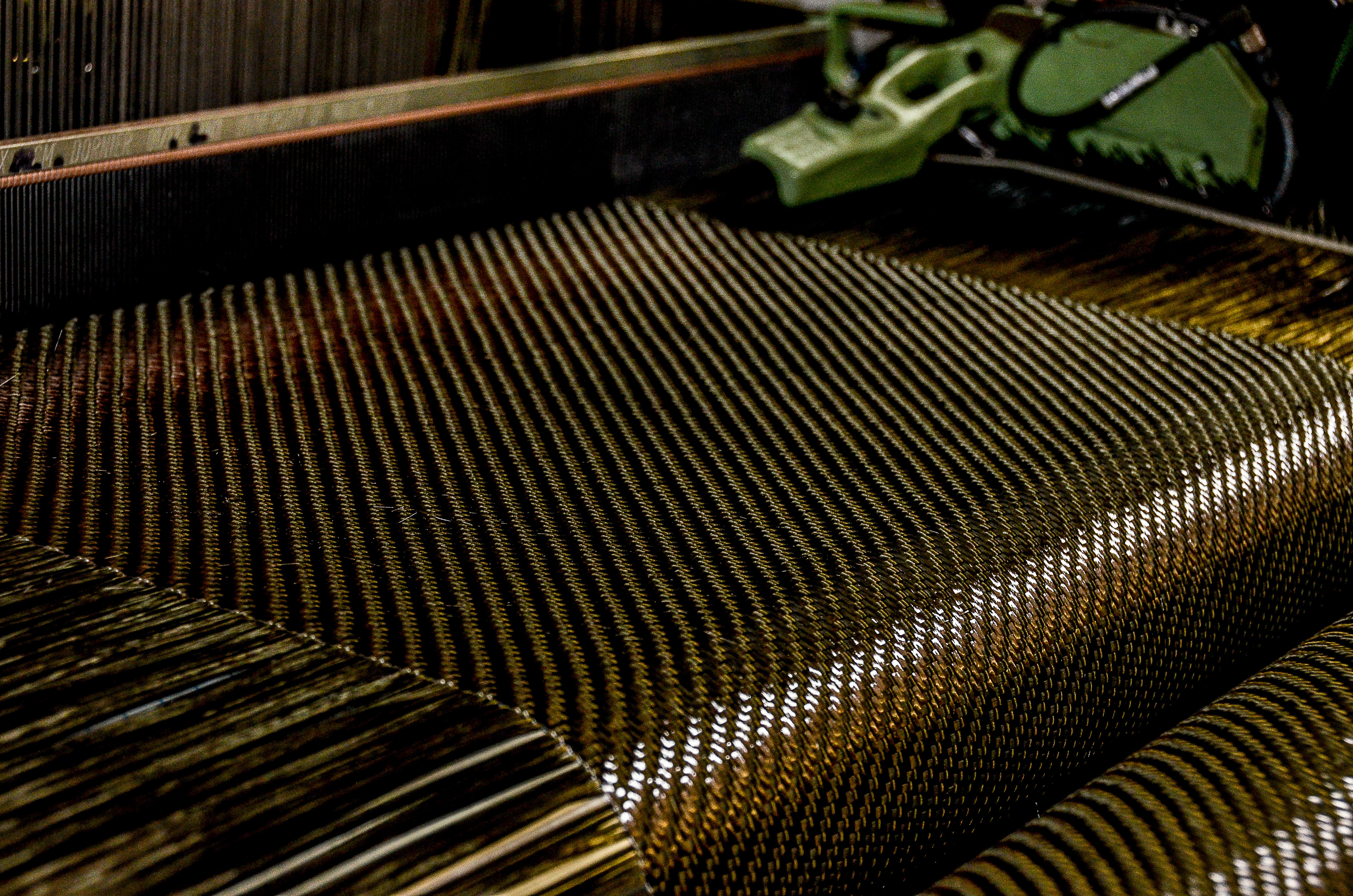
Tensile strength is one of the primary mechanical parameters used to classify industrial fabrics. Whether a material is destined for geotechnical reinforcement, protective clothing, or composite laminate production, the same question applies: how much force does it take to rupture the fabric under controlled conditions?
The answer depends heavily on how the test is conducted. EN ISO 13934-1 (strip method) and EN ISO 13934-2 (grab method) produce different values for the same fabric, and comparing figures from different methods without accounting for this difference leads to significant errors in procurement and quality documentation.
EN ISO 13934-1 — Strip Method
In the strip method, a rectangular specimen — typically 50 mm wide and with a gauge length of 200 mm — is clamped along its full width and pulled at a constant rate of extension until rupture. The test is performed separately in both warp and weft directions, and results are reported in Newtons (N) or kilonewtons per metre (kN/m) for geotextiles.
Key parameters recorded:
- Maximum force at break (N)
- Elongation at maximum force (%)
- Force at specified elongation (for geotextiles)
The strip method is the standard reference for woven industrial fabrics used in construction, filtration, and reinforcement applications. Because the specimen is clamped across its full width, lateral contraction is restricted and the test reflects the structural behaviour of the weave more closely than grip-based alternatives.
EN ISO 13934-2 — Grab Method
The grab method uses a narrower grip — typically 25 mm wide centred on a 100 mm specimen — which leaves material outside the clamp area to contribute to load resistance through lateral tension. This produces higher apparent tensile values than the strip method for the same fabric.
The grab method is more commonly used in apparel-adjacent technical textiles, including protective clothing outer shells and some filter fabrics. It is also used where the strip method is impractical due to fabric construction (e.g. heavily three-dimensional knits).
Important: tensile values from EN ISO 13934-1 and EN ISO 13934-2 cannot be directly compared without a conversion factor, which itself varies by fabric construction.
Tensile Strength of Common Industrial Fabric Types
The following reference ranges are based on published material data sheets and EN 13249-series annexes for geotextile products. Actual values depend on areal density, yarn type, and weave construction.
| Fabric Type | Material | Tensile Strength (warp/weft) | Elongation at Break |
|---|---|---|---|
| Woven geotextile (light) | Polypropylene | 15–40 kN/m | 12–25% |
| Woven geotextile (heavy) | Polypropylene / Polyester | 80–400 kN/m | 8–18% |
| Nonwoven geotextile | PP spunbond / needlepunch | 8–25 kN/m | 40–80% |
| Aramid woven fabric | Para-aramid (Kevlar/Twaron) | 600–3000 N/50mm | 2–4% |
| Carbon fibre woven | Carbon fibre, 3K–12K | 3000–8000 N/50mm | 1–2% |
| Glass fibre woven roving | E-glass | 1500–4500 N/50mm | 2–4% |
| Industrial filter cloth | Polyester / Polypropylene | 1200–3500 N/50mm | 18–40% |
What Affects Tensile Strength in Woven Fabrics
Yarn Tenacity
The base yarn determines the theoretical maximum. High-tenacity polyester and polypropylene yarns (HT grades) typically reach 6–8 cN/dtex, compared to 3–4 cN/dtex for standard grades. Para-aramid yarns reach 20–25 cN/dtex, which explains why aramid fabrics punch well above their weight in tensile performance for a given areal density.
Weave Construction
Plain weave distributes load across a high number of yarn crossings but introduces crimp — the sinusoidal path the yarn takes as it interlaces — which reduces effective load-bearing length. Twill and satin weaves reduce crimp and allow higher load transfer, at the cost of some tear resistance in certain directions.
Areal Density
Tensile strength in kN/m scales approximately linearly with areal density (g/m²) for fabrics of the same yarn type and weave. Geotextile datasheets typically report both parameters to allow cross-product comparison.
Finishing and Coating
PVC, acrylic, and polyurethane coatings add stiffness but may reduce elongation. Some coatings bond to yarn surfaces and increase effective cross-section, yielding a modest tensile improvement. Heat-set finishing on polyester fabrics locks the weave geometry and slightly increases modulus.
Nonwoven Tensile Behaviour
Nonwoven fabrics tested under EN ISO 9073-3 behave differently from woven materials under load. Because fibres are randomly oriented or arranged in specific machine-direction (MD) and cross-direction (CD) patterns, tensile values differ significantly between the two directions.
Needlepunched nonwovens typically show MD/CD tensile ratios of 1.2:1 to 2.5:1, depending on the number of needle passes and needle orientation. Spunbond PP nonwovens show ratios closer to 1.5:1. Thermobonded fabrics with regular bonding patterns show more isotropic behaviour.
Unlike woven fabrics, nonwovens continue to elongate significantly before failure, which makes them suitable for applications where strain distribution is needed — filtration membranes, drainage layers, and separation geotextiles being the primary examples.
Reading a Technical Data Sheet
When evaluating tensile data in a manufacturer's technical data sheet for an industrial fabric, check:
- Which standard was used (EN ISO 13934-1 or -2, EN ISO 9073-3, EN ISO 10319)
- Whether the value is for warp, weft, MD, or CD direction
- What specimen width and gauge length were used
- Whether the value is at maximum force or at a specified elongation
- What testing laboratory issued the results, and whether it is accredited under EN ISO/IEC 17025
Data presented without this context is difficult to compare between suppliers, particularly when geotextiles from different product families are being evaluated against a project specification.